

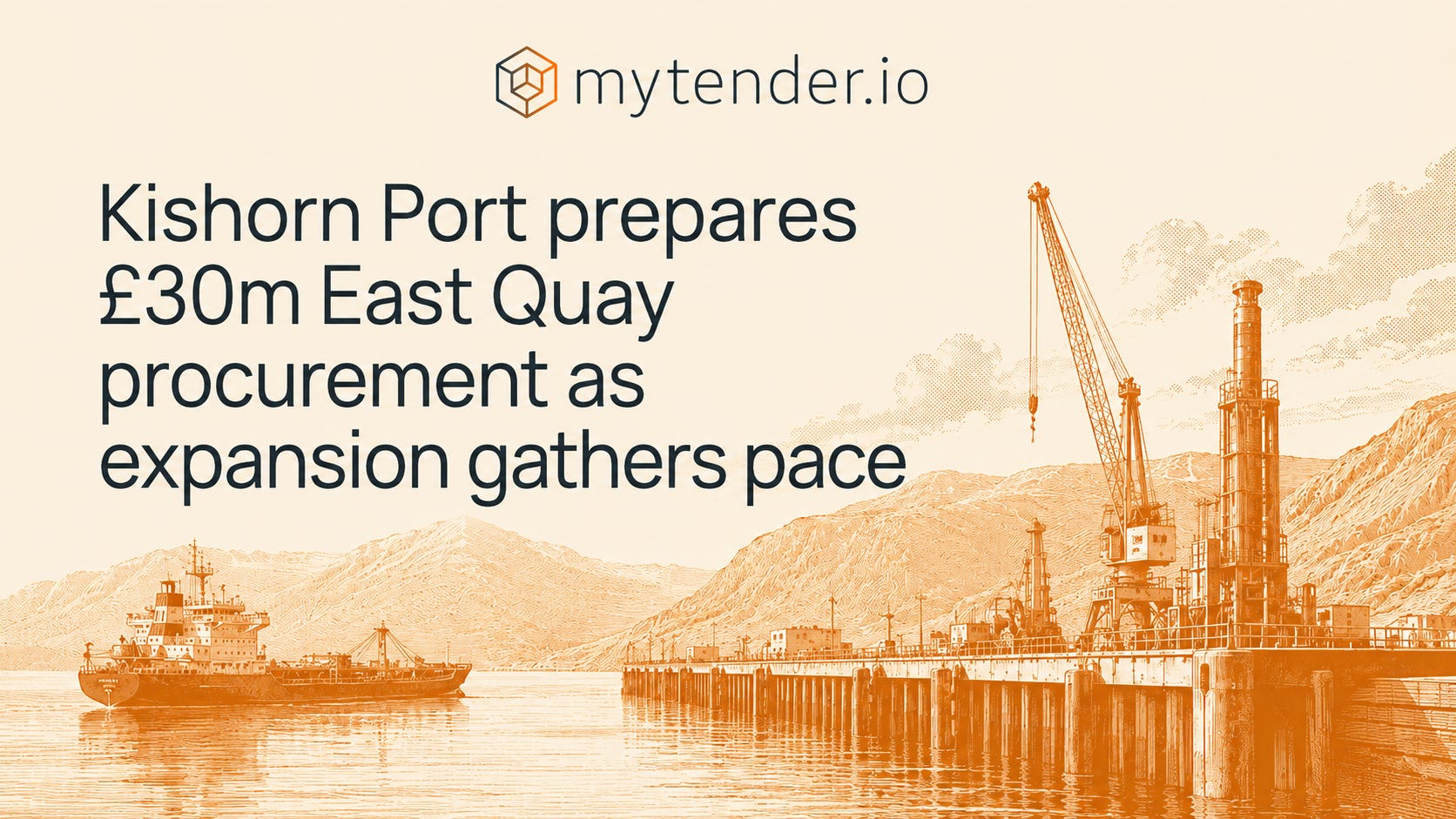
Kishorn Port is preparing to move ahead with the next stage of its redevelopment, with plans for a new deep-water quay expected to create a major contracting opportunity worth around £30m.
The proposed East Quay will extend 150 metres and will be built on newly reclaimed land created during the first phase of the port’s expansion. Once complete, it will offer a water depth of 12 metres below chart datum, strengthening the Wester Ross port’s ability to support offshore wind, decommissioning and wider marine infrastructure projects.
The package is expected to include a range of heavy civil engineering works, including sheet and combi piling, tie rods, concrete capping beams, quay furniture, lighting and service installations. The project will also involve the construction of two piled mooring dolphins, linked to the quay by steel walkway bridges.
A temporary piling bund is set to be formed using rock material generated during the earlier phase of works. That same material will later be repurposed as infill behind the new quay wall, supporting a more efficient use of resources across the redevelopment.
Kishorn Port Limited is expected to shortlist up to five contractors, with the winning bidder appointed as principal contractor. A formal contract notice is anticipated in September, with tender documents expected to follow in November. The current programme points to contract award in April 2027, ahead of a planned construction start in June 2027.
The East Quay project, known as Phase 1B, follows the £42.2m first phase of investment at Kishorn, which has focused on enlarging the port’s dry dock and reclaiming 8.5 hectares of foreshore.
RJ McLeod was appointed principal contractor for Phase 1A under a £20.9m construction contract awarded in June 2025. That phase includes cutting through rock to extend the dry dock by around 100 metres in length and 60 metres in width.
Approximately one million tonnes of excavated material has been moved and reused to form the reclaimed land that will support the future East Quay. The wider works also include new roads, drainage, mooring infrastructure, rock protection and a reinforced-concrete working slab.
Phase 1A remains on track for completion in September or October. Once finished, the expanded dry dock will be able to accommodate vessels up to 260 metres long and 160 metres wide.
Highlands and Islands Enterprise has contributed £24.3m towards the first phase, with the balance funded by Kishorn Port Limited. The support forms part of the Scottish Government’s wider commitment to invest up to £500m over five years in ports and the offshore-wind supply chain.
Should the East Quay contract be awarded at its estimated value, the combined investment across the two main phases of the current expansion would total around £72m.
The latest development continues the long-term revival of Kishorn’s dry dock, which began returning to active use in 2017 after more than two decades of limited activity. The site was originally developed in the 1970s for the construction of the Ninian Central oil platform.
What this means for infrastructure bidders
Projects such as Kishorn’s East Quay highlight the growing complexity of public and private infrastructure procurement. Major marine, energy and civil engineering opportunities now require bidders to respond with greater speed, stronger technical evidence and tighter commercial control.
For contractors targeting large-scale port, energy, decommissioning and offshore wind schemes, the challenge is not just identifying the opportunity. It is producing a high-quality, compliant and differentiated tender response under pressure, often across multiple stakeholders, technical disciplines and submission deadlines.
This is where mytender helps bidding teams work more effectively.
mytender supports organisations by bringing structure, automation and consistency into the tender response process. Teams can use it to manage bid content, accelerate first drafts, improve answer quality and keep submissions aligned with buyer requirements, while maintaining the governance and oversight expected on high-value opportunities.
For businesses competing in sectors such as construction, infrastructure, facilities management, marine services and energy, platforms like mytender can help turn complex procurement documents into clearer, faster and more controlled bid workflows.
Check out some case studies below:
Stadium FM
“Stadium FM have been using the brilliant mytender.io platform to save a ton of time and headaches, whilst being able to win more work.”
Professional Security
“The customer service is impeccable... We have saved in excess of 250 hours on just 9 tenders already.”
Empro
“I have worked with Sam and the Team at mytender.io for the last year and have seen the tool develop and transform into an innovative industry-leading platform…”
robidco
“mytender.io is the best AI tender writing tool I’ve seen and used, and way ahead of anything Gemini/Copilot can achieve. I’m still trying to find the right analogy to…”
Paprec
“mytender.io has completely transformed how we approach bid writing. What impressed me most wasn’t just the time savings - though cutting 75% off our tender prep time is huge - it was how the quality actually improved.”
Mount Charles
“We have noticed that the more we use the system the more it reflects our writing style. Based on the feedback from awarded bids we are scoring higher and more consistently on quality.”
The Society of St James
“mytender.io has transformed how we approach grants and tenders, saving huge amounts of time on analysis, documentation, win themes and drafting. I can now focus on quality, model and continuity rather than word counts and compliance checks.”
Source note: This article draws on Construction News, supplemented by Public Contracts Scotland